Monday, October 22, 2007

The Mysticism of William C. Gannett


I've been reading some material on the Western Unitarian controversy of the 1880s. This was an earlier reprise of the questions "what is the center of our movement?" and "what falls outside our movement?". I've read a handful of papers and tracts from the period, most of them dry, almost legal briefs, ponderously rationally laying out arguments. I expected the same of Gannett's writing, only more so, as he was part of the radical element, the sort of proto-humanists who were leaving behind much of the Christian aspects of Unitarianism. I was wrong. I could read him with my heart.

Gannett speaks of religion as the "inner central fact of the soul's life -- the sense of aspiration for unfulfillable ideals, the lightning flash of indignation against strong-handed wrong, and the white glow of reverence for the martyr... and that mystic working of spiritual elements in us which gives cheer in trial, quiet in sorrow, patience in strain...." Then this, which seems to anticipate process theology: "God-becoming within atom-limits is the imperious and blessed condition of God-realizing". Wow. "Is this Power working thus within us, Love or is it Lover?" I'm going to be pondering this for a while.

Gannett served Unity Church from 1877 to 1883. This was before the congregation moved to its present building, so his ghost is not in the physical structure. But I'm sure he lives on in the interior spiritual life of the congregation that is Unity Church.

Friday, October 12, 2007

Corn and Grass


I just returned from a couple days at a ministerial retreat at Shalom Center, a retreat center for ministers founded on an old farm in southwestern Minnesota. The center was designed to have a light footprint on the earth, with buildings set in the hillside that require minimal heat or cooling, emphasis on locally grown food for meals, a wind power plant, and surrounded by land that is being returned to prairie.

I was able to walk for a couple hours on the prairie and enjoy some time in nature and away from others. The ecological connections were palpable, the spirit of the land hung in the air. It was hard not to hear the whispers of Aldo Leopold or Wendel Berry in this place. And yet across the way corn was being mowed down by a combine, most likely to be processed into ethanol, the current speculative market expansion scheme of agribusiness. The giant machine whirred along, casting a cloud of dust, with headlights on, working well into the night. It would be easy to hate the corn and love the grass, but I know it is so much more complicated than that.

Tuesday, October 09, 2007

Belonging and Believing


One of our board members loaned me the book "Growing an Engaged Church" by Albert L. Winseman, a Gallup researcher. While I've become much more attached to narrative and story, my inner quant does love good data and good analysis, which Winseman provides. His data suggests that people choose to become involved in a church (or any group) when they can answer affirmatively two questions: "Am I valued?" and "Do I make a meaningful contribution?". People turn this involvement into engagement because they see clear and relevant answers to these four questions: "What do I get?", "What do I give?", "Do I belong?", "How can we grow?".

Winseman discovers a surprising thing: engagement drives spiritual commitment, not the other way around. "Belonging leads to believing", not "Believing leads to belonging", Winseman concludes. Unitarian Universalists in particular need to take note. While we claim to be non-creedal, we tussle with belief. So many of us come out of other faiths, often rejecting those old belief statements, and we come into this tradition with strong attitudes about belief. We get focused on believing (or unbelieving) and forget about the 'oh so ordinariness' of belonging. Rather that we would focus on how people can be with us, how they can belong, and less on talking about what we all should believe.

Saturday, October 06, 2007

What a New Generation Thinks


Carol Howard Merritt over at Tribal Church pointed to an article "A New Generation Expresses Its Skepticism and Frustration With Christianity", which suggests that young people, ages 18-29, are increasingly dissatisfied with Christianity (defined broadly). The Barna Group, a marketing research group for churches, suggests this is not a passing fad; they claim to have longitudinal data that shows that this trend has been developing for at least ten years. A big part of this dissatisfaction is the association of Christianity with conservative values, especially homophobia. However, much of the reaction was based on people's "personal interactions with Christians or in churches" which often involved "truly ‘unChristian’ experiences."

So I wonder where Unitarian Universalism fits into all this? In general, our values stand in opposition to the ones the young people identified as unappealing in Christianity. The form of Christianity found within the UU movement, based strongly on the wisdom rather than the divinity of Jesus, might well be appealing to many of these people. Many of these young people should find our congregations to be attractive faith communities. But do we even welcome them in? I think we are learning to do this, in fits and starts, and this makes me very optimistic for the future of our movement.

Image from the Barna Group.

Tuesday, October 02, 2007

The Veil Becomes Thin

We are restarting our Elders program, which meets monthly in the daytime. From what I've learned from notes and discussions, the group has had a variety of formats over the years, from lectures and presentations to group discussions about specific topics. I understand the format this group enjoyed most was discussion about a topic close to their lives. One of the most successful topics last year was simply titled Mothers.

I've chosen a title for the October meeting, "The Veil Becomes Thin", and we will be invited to explore, in a time near All Souls Day, Halloween, and Dia De Los Muertos, our connections with ancestors and friends who have passed on. I hope, through facilitated discussion, we might go to interesting places with such a discussion. How are these people still present in you lives? What spiritual connections remain? How do they guide or affect your lives? I don't know this group, so I'm looking forward to this with an open curiosity and interest.

I read one piece of advice in an article on blogging: keep it short. They recommend under two paragraphs. So that's what I did today, then broke that rule by adding this paragraph! Which is what we're sometimes meant to do with rules.

Thursday, September 27, 2007

Worship with Projection 101


Yesterday I presented my first worship service, a short intergenerational service called Wellspring Wednesday. I tried something new for this worship, and prepared a set of projected images to support my message. It seemed to go well, and the children, who often get squirmy, paid careful attention.

When I watched Al Gore present on-stage in "An Inconvenient Truth", I was amazed at the software he used, and realized it was essentially Keynote, Apple's presentation software. I immediately bought a copy, and loaded it on my trusty Mac iBook G4. I've since added a Griffin Airclick USB remote control, so I can advance slides while away from the computer.

I built my slideshow as simply as possible: a set of images with no fancy transitions. I used a combination of my own images and photos downloaded from flickr. I was careful to use only images that were shared under Creative Commons licenses; you can restrict your search in flickr to these under advanced search. I did add a credits screen at the end. I included some text screens for song lyrics, these were the simplest white font on black. (Note that licensing is a concern when projecting lyrics.)

One of the places where Keynote really shines is during the presentation. The screenshot above shows what you see on your notebook screen. The projector is showing the left image, and the right image is the next image. I am amazed at how valuable knowing what the next image is when you are trying to ad lib a transition to that image. Having the time of day is useful too, though the elapsed time was less useful to me. Notes are below, also, and were very helpful as a stress reduction tactic.

Our projector, on an old AV cart, and a portable screen left over from the 1960s rounded out the equipment list. I worried about light pouring in through stained glass windows behind me, but the sun was low enough so that wasn't a problem.

Technically, things went without a hitch. When worship was done, I raced the computer and the AV cart down to another meeting room where a workshop using DVD clips was to be conducted, and that, too, went without any glitches. We trust our technology so much more these days. I didn't even have a real back-up plan in place -- a far cry from the days when I would routinely carry overhead transparencies or printouts in case something went wrong.

Tuesday, September 25, 2007

Three Memorial Services


This was a busy weekend at the church. At a time when many of the fall programs are hitting their stride, we had three deaths in the community, and the three memorial services were scheduled for this weekend. It couldn't be helped. As Rev. Janne says, "we don't say no to a memorial service" for one of our extended community. Thus, I found myself helping out, trying to be a pastoral presence, a source of calm in the swirl of activity around such services. This, while I lit candles, set up chairs, and handed out orders of service. I was just one of many wonderful staff people and volunteers that offered their help.
I observed different levels of involvement by friends and family at these various services. I'm realizing that some people need a high level of activity immediately after a loss, possibly as a way to cope with their intense emotions around the loss. For others, such activity may just add to the chaos, and they may avoid even attending a memorial service at all. Such people may even ask that a service not be held for them after they die. But I do believe that the memorial is for the living: in the weeks and months that come after a death, the memorial service becomes an important memory and a clear way to mark the closing of a chapter in the lives of those who live on.

Image by Magnus Forrester-Barker

Saturday, September 22, 2007

Diversity in the Balance


One of the conversations in the air at Unity Church is the value of diversity and the need to become a more diverse community. This is not a new conversation, and this desire is encapsulated in the ends statements of five years ago. So when I encounter stories of other churches which have become more diverse, such as this New York Times article, I pay attention, even when they are vastly different from this Saint Paul setting.
Briefly, the NYT story describes the transformation of Clarkson Baptist Church in suburban Altanta, a dying all-white traditional southern church, into Clarkson International Bible Church, a growing multicultural church.
Certainly the theology of this conservative evangelical Southern Baptist congregation is quite foreign to that almost all Unitarian Universalists would espouse, but that's not the point. The church saw in their theology a need to reach out to a growing community of African and Philippine and Vietnamese immigrants, and they responded to this call, though not without internal conflict.
Do we UUs find in our broad theological base a similar commitment to invite into the community all who might need us?
The diversification of the Clarkson church was a result of a confluence of several factors. The surrounding community became a settling place for large numbers of immigrants over the last few decades, much as parts of the Twin Cities have become. Initially the church rented out space to separate immigrant congregations which worshiped in their own styles and languages. This brought close, but 'safe' contact. But inviting some of these immigrant churches into the main worship meant change and conflict. Some people left, and those who stayed find they miss some things lost, like the older hymns and sermon styles.
Would UU congregations be willing to give up that much? Would welcoming others of many cultures, with their diverse ambitions, experiences and hopes more than balance out those losses? I do this work in fervant belief that it will be so. As I write this, my iTunes begins pumping out Zimbabwean John Chibadra's "Zuva Refuka Kwangu", a small reminder to me that it will be so.

Thursday, September 20, 2007

Journaling as Spiritual Practice

Yesterday in a staff meeting, we had a brief discussion of spiritual practices. Amidst some interesting practices such as setting out seasonal decorations or making the bed each morning, (and with one of ours offering a sermon recently on "Chicken Keeping as a Spiritual Practice"), I almost felt that my offered practice seemed, well, ordinary. My ordinary and boring practice is keeping a journal, and I admitted I don't even do a good job of it.
For years I struggled to keep written journals, starting as high school class assignments, and then as reflection tools. I'd invariably keep these up for a time, then quit writing. I do better now, more on than off, and I think part of the reason is technology.
I'm a left-handed writer, so writing more than a few words with a pen has always been a chore. Pushing the hand along smears the work. Fancy blank books have bindings that get in the way; spiral notebooks just hurt when you lay the hand on them.
I've learned that the keyboard is my tool of choice. I've figured out that the easiest way for me to journal is to write myself an email. I give it a title with the word Journal in it, and a gmail filter automatically routes these messages off to a special folder and marks them 'read'. These emails lay around, rarely read, as for me, most of the benefit of a journal is in the writing, not the reading.
Every now and then, though, I find I need to recover something. Rather than flipping through pages, I can use search to find key words. Often I get little surprises this way, for there may be similar items I've forgotten about: like entries about the constant rain my first spring in Berkeley. Then it is fun to go find the entries near that item, and recover a taste of that time.
I'm not going to pretend this made my journaling practice a deeply grooved habit, as there are still big stretches of time where I just am too busy or stressed to write. But this journaling method is accessible - I can jot a few sentences down into a draft email whenever I have a free moment near the computer. And I don't worry about losing my notebook.

Monday, September 17, 2007

Prairie Home Companion Weekend

This weekend was a double-dose of Prairie Home Companion. On Friday, we went to the performance at the Fitzgerald Theatre here in St. Paul. I had been introduced to the show some 27 years ago when I was at Purdue, in Indiana, so some of the Midwestern references made sense to me. Now, as a person who lives in St. Paul, many of the other inside references made sense: cheese curds, I-94, and Hennepin County Library are some I picked out. Certainly a great part of the appeal of this show is the great number of references to details of life that we are familiar with, from the feeling of the first day of fall to deer at dusk on the highway to bagging your carry-on gels and toothpaste at the airport.
I also enjoyed the sense of production of the show: what was read from scripts, what was extemporaneous (most of Garrison Keillor's speaking was without notes), the musicians riffing and playing off each other and off the spoken parts. Keillor's monologue on Lake Wobegon was nearly sermon length, and seemed quite extemporaneous. Fabulous music by the Derailers (though I was bothered by several people taking flash pictures with camera phones - what's with that?), and the house musicians are top-notch.
On Saturday night, we joined a friend of Liz's at the last minute for the annual PHC Meatloaf Supper and Streetdance in front of the theater. Now, I'm no fan of meatloaf, but the $5 plate of meatloaf and white sides was pretty good! We enjoyed a warm night with maybe two thousand other folks, listening to Keillor mc the contests for loon-calling, loudest kid, and best Bob Dylan imitation, among other things. This sort of energy and creativity and variety is why we love living in the city. Size brings anonymity, and anonymity -- for all its benefits -- often invites the worst to come out in people. The fact that a big crowd of strangers like this one can behave well together is a beautiful and hopeful thing.

Thursday, September 13, 2007

9-11 and "The Guys"

This is the week of the sixth anniversary of 9-11, and many of us have reflected on our changing attitudes about the events of that tragic day. Some of my thinking was driven by the film "The Guys" with Sigourney Weaver and Anthony LaPaglia. LaPaglia plays a NYC fire department captain that must eulogize a number of his company who died in 9-11, and asks Weaver, a writer, to help him write the eulogies. The film, based on a screenplay, was recommended to me as a new minister as it provides a good textbook education of this task.
LaPaglia must present memorial words for both familiar old friends and unknown new firefighters. Weaver helps him (and us) understand that while they are all heroes, they must at the same time be remembered as humans with all their quirks and uniquenesses.
As one who expects to assist people in expressing their remembrances of the lives of family or friends, I found this most helpful and reassuring. I have consoled people who have lost loved ones before, and I understand some of this, the remembering, the questions why, the pain, but it was good to see how one does the work of transmitting all this, of forming it into something that could be spoken to an audience of family, friends and strangers.
But this play has incredible passionate power, and tears emerge unexpectedly. I grieve even as I write this. The Guys was written shortly after 9-11, by Anne Nelson, and first presented off Broadway on Dec. 4, 2001 according to the IMDB website. The play carries a rawness about the event, a locality and presence that is now long gone. I remember that feeling. In the pain of those early days, there was one thing I rejoiced in, and that was the connection that we all felt with those around us. And yet, this connection is a scary feeling for most of us; we avoid these emotions. Even in the play, the firefighter struggles at times with the intense emotions he has around his guys, and Weaver wisely brings him back to those emotions so that the work of remembering could be done.
I think as a nation, we collectively chose to avoid these emotions. As a nation we sought anesthetization. I think I can now begin to forgive President Bush, for he was a mere instrument, a tool, that we used as a nation to help us avoid those feelings. Our invasion of Iraq let us off the emotional hook, and we set these hard issues aside. We could blame Saddam rather than rail against God, we could strike out instead of just be present with our pain.
Part of remembering is returning, it is trying to recover the sense, if not the intensity, of the emotions we felt at that time, in that place, with those persons who we remember. Words are weak tools for doing this, but most times they are all we have. I feel honored to be in the role of crafting those words for others.

Saturday, September 08, 2007

Picking up the Pace

Tomorrow marks "opening day" for many churches, the day when they switch from a more relaxed summer schedule to the fall pace. According to the local paper, many churches call this "Rally Sunday", or "Kickoff Sunday", or "Homecoming Sunday" or some name apparently drawn from the world of football. The term used at Unity is "Service of Reunion", which at least sounds appropriately religious.
Tomorrow, we go from one service to three, our Wellspring Wednesday evening service and programming starts this week, and Religious Education starts next Sunday. I'm already feeling the heightened energy that this pace brings. I've been to several Pledge Team meetings this week as they prepare for the launch of the stewardship program in a few days. It is easy to get drawn into such a frenetic pace, with so much going on, to begin to do everything in a hurry, to try to be all things to all people.
The name of this blog is Slowing Down, which is my reminder to myself that there is a better way than frenzy. Slowing Down is one of the points of the Eight Point Program, which is the foundation of my daily spiritual practice.
For me, slowing down is being mindful of the tasks I choose to take on. I try to avoid overloading myself with commitments and activities that I cannot complete, so that I can do what is most useful to those around me and to myself. I try to pace myself, so that I don't find myself doing unneeded rework. I also try to keep my perfectionist tendencies from causing me to waste time with unnecessary thoroughness. This is very hard for me at times.
A friend says he "slows down in order to go fast." If going fast means attending to what is truly important, and letting go of the rest, I am striving for that kind of speed.

Wednesday, September 05, 2007

White Light, Black Rain


Liz and I watched White Light Black Rain, about survivors of the bombing of Hiroshima and Nagasaki, yesterday. This film is by Steven Okazaki, of Berkeley. As a Japanese-American, he is able to integrate elements of both cultures in his film-making that I haven't seen in other documentaries on this subject.
This is a hard film to watch, as Steve doesn't shy away from some of the difficult aspects of these attacks. The image of the man with his ribs showing between bedsore lesions still sits behind my eyes. The woman, who talked of her sister committing suicide, who said, "there are two kinds of courage, the courage to live and the courage to die", and noted, without judgment, both her and her sister's courage in their choices. It was perhaps the non-judgmental tone of these survivors that may be most bothersome to many who watched this film. I have been told that the people screening it at Sundance just sort of felt numbed, and came out of the theater without emotion.
This non-judgmental attitude seemed like the right thing to me. Perhaps it emerges from the strong Buddhist sensibility of many Japanese people. It may also come from that clarity that comes near the end of life, even one marked by loss and suffering, when one realizes that anger or self-pity no longer serves. This attitude of just being could be something to aspire to, but it is hard for me to imagine, as one who has not been tested like these survivors. And yet a deep compassion, an unexplainable humility, wells up in me as I hear their stories. I must balance the levels of stoicism and emotionality, to find the best possible life, even amidst great horror.

Sunday, September 02, 2007

Ceili from my Mobile


This is a little experiment to see what happens if I try to post from my mobile phone. Pushing the limit, I'm also attaching a picture of Ceili, my dog, being her usual cute self, which was also taken on this mobile phone.
I'm going to note that I have to do a little icky HTML editing to float the picture to the right, as it is here, and as yesterday's post is set up. Not ideal, as it would be really nice if the picture and the text from an email just dropped into their proper places. But I'm revealing my inner geekiness to just be thinking about that minor form of perfection in this world.

Saturday, September 01, 2007

Why Blog?


Why indeed? Part of the rationale is that this is my internship year with Unity Church, and I hope to capture some of my experiences here, and share them with others, friends at school, people considering ministry, folks at Unity that might care to know more about me.
A deeper reason is that this blogging is new and a bit scary stuff for me. I also tend to be a private person, quiet, and so this seems like work to me, not verbal release as it might be for some others.
I'm a pretty sporadic journal writer, and those journal entries are just to myself. I hope I can find a better sense of my public and private voices in writing this, and hold true to the sense that this ought to be of use to people, not just the ramblings of some overcharged ego running amuck.

Getting Started

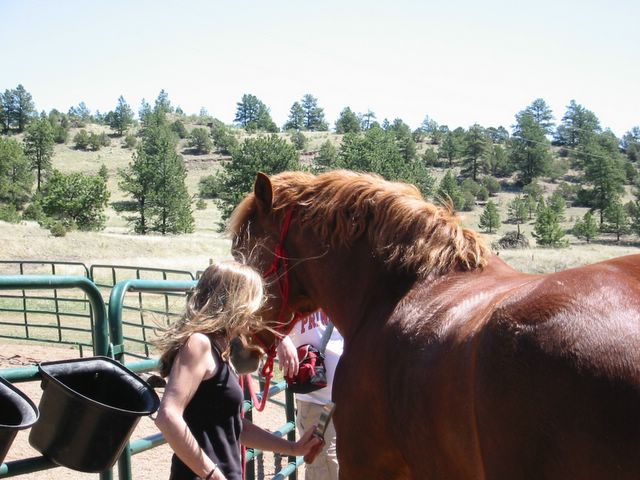
I did some quick web research, and decided that, for now, Blogger would be a good choice for this project. I began to set up the blog, and found that the username 'malspaugh' was already taken. That seemed kind of unusual, so I typed in malspaugh.blogger.com, and up popped some very old pictures from my Clinical Pastoral Education (CPE) program near Florissant, Colorado. While my clinical training was in a hospital, the supervisory sessions often involved working with horses, as the pictures show. I had completely forgotten about these experiments at posting, and it was both a pleasant surprise, like finding an old picture in a book. It is also a somber reminder that anything put on the web has an unusual permanence, like finding an old picture of you and some long-gone ex-partner in a book - one you just checked out of the library!

Saturday, June 11, 2005


Pikes Peak in the background Posted by Hello

some pretty big draft horses Posted by Hello

easy riding Posted by Hello

brush 'em down Posted by Hello